
Enneagram Wings Do Not Exist
We've flown too close to the compulsive-subtyping.

The question of “why do wings exist?” has circulated through Enneagram discourse as though the answer isn’t lodged between the first few pages of a notable Enneagram book. It is the general consensus that they have the purpose of being additional traits borrowed from the adjacent types to explain exceptions in behaviors and orientations in people.
The wing-component creates a distinct line of expression between two personalities of the same core type. The only issue is that this is completely unnecessary and deserves to be questioned and understood instead of merely accepted as part of the intentions of the enneagram.
WHAT ARE WINGS AND WHERE DID THEY COME FROM?
A point’s ‘wings’ are the adjacent types relative to their positioning on the Enneagram symbol. For E4, the ‘wings’ are E3 and E5. For E8, the ‘wings’ are E9 and E7. It carries on this way for each Enneagram point. Hexadic types (1-2-4-5-7-8) have one adjacent point that is within its center and one outside of it. Both adjacent points for triadic points (3-6-9) are within their center. This positioning inherently contains information about the process and interchange happening between the points relative to the theme of Enneagram being portrayed upon it.
‘Wings’ as a concept exists in the Enneagram of Personality to explain the nuances of behaviors demonstrated by personalities of the same core type. It posits that these nuances are due to the borrowing of characteristics from the adjacent types in support of the core. To illustrate: a 9w1 and a 9w8 encompass different archetypes of E9; with 9w1 as the spiritually-inclined philosopher with heightened airy meekness, and 9w8 as the more rugged unintrusive yet unapologetic comfort junkie. 9w1 is a cleaner E9 than a 9w8 since it is borrowing from E1’s finicky existential pickiness and self-righteousness.
The concept was created and spread during the late 1970s by students of Naranjo. In the 1980s, it was popularized. The key piece of Enneagram literature that contributed to the modernization of ‘wings’ is Personality Types: Using The Enneagram For Self-Discovery, published in 1987 by Don Richard Riso and Russ Hudson.
“We are the first authors who have done sufficient research into the wings to be able to make these wing subtype distinctions, and we are making them available here for the first time.” (pg. 11)
As one continues to read from that point forward, the crux of ‘wings’ relies on the premise that individuals contain all 9 types simultaneously and get ‘stuck’ on specific ones during development as a result of traumas, gradual conditioning, or it happens outside of development as simple predisposition.
For the record: individuals do not have all 9 types. More on that in a future post.
The issue is that the originating authors themselves do not seem to understand the limited scope of their concept. ‘Wings’ are merely observed and named categories that contain as much variability in expression as the core type itself. It becomes a way to account for the self-reports of a person claiming to be outside of the scope of the Enneagram itself and to resolve useless contradictions that wouldn’t be there if the concept wasn’t so loose in the first place. In their own words, “people will show a very strong influence from their wing, while in others…the influence may be slight. Some people…insist that they have a degree of influence from both wings, and in a certain number of instances this may be so. Moreover, everyone has both wings in the sense that to some extent we all have all nine types in our personality.”
In an attempt to make sense of this variability, they decide to contain the numerous exceptions by classifying each type-‘wing’ combination as an entirely separate subtype. This goes forth to birth the recognizable title-pieces of “4w3 Aristocrat” and “7w6 Entertainer” composited of one-dimensional characteristics and observed traits that lose the quintessential nature of the type itself in an excessive need to multiply categories. On page 4, the authors disclose that “the vast majority of people that [they] have encountered have a dominant wing, and they can be distinguished from members of the same type who have the other wing. The basic type and wing result in a blend which is distinct from the other type-wing combination…so much so that they can be viewed as separate subtypes.”
This model gives way to the present where there are now 18 micro-types (the difference isn’t large enough to be called sub-) artificially multiplied by the 27 instinctual subtypes created by Naranjo. 36 different type-‘wing’ combined with singular dominant instinct subtype combinations are possible in exclusion of the full instinctual stacking. Because surely a Sexual 6w7 is far different and deserving of its own separate category from a Sexual 6w5. It becomes a question of how hyper-individualized the authors of the Enneagram of personality intends to stretch it to be.
As an honorable mention, one netizen with the alias of Jase took advantage of the concept and even made ‘subwings’. The core of this theory is that there is a core type, the ‘wing’ which acts as a more overt expression, and a ‘subwing’ that converts a felt underlying and almost negligible mechanism into something named. This combined with a dominant instinct creates over 72 types. You can read their descriptions of it here. It’s a fun write-up to consider.
ICHAZO’S OVER-UNDER DICHOTOMIES
In Ichazo’s original Enneagram, the types are distinguished by which domain of social and survival related complication their consciousness is oriented towards. These domains contain specific sensitivities and perceptions utilized to keep the ego churning nutrients for its trap.
The closest that he gets to ‘subtypes’ are archetypes embodied by each domain being over-done or under-done and either positions are treated as phases of the fixation that can fluctuate or exist simultaneously. Positively desirable and negatively unhelpful traits of the domain contribute to the expressions of the over-under archetypes.
Taking a piece of Ichazo’s Enneagram, E3’s domain of consciousness is that of creativity. It is named ego-displayer because it compensates for it’s relational issues by displaying itself as valuable enough to be included within the social sphere. The over-displayer is the character that is hyper-efficient, authentic, and deceptive. The under-displayer’s character is the loud-mouth boaster that lies to others about their capabilities and intentionally withholds aspects of their personality deemed shameful. The positive of the domain are the traits of know-how and fantasy while the negative of the domain are traits of cunning and daydreaming.
The contemporary interpretation of this over-under approach to a core fixation would be a type’s wings.
Continuing with the E3 illustration, it could be said that a ‘3w4 professional’ would be the under-displayer and the ‘3w2 star’ as the over-displayer, each with alternating configurations of the positive and negative traits. However, I want to remove the words positive and negative since it doesn’t properly articulate the mechanism being observed. What is deemed the ‘negative’ qualities of the E3 (cunning and daydreaming) are the root qualities that determine whether or not the expression is over-or-under. The ‘positive’ qualities are accentuations atop the root that assist in expression.
In the description given by Personality Types, it is said that ‘3w4’ “may have artistic sensibilities and creative ability, and often possess a strong sense of style, especially in regard to their homes and their personal appearance. They usually emphasize intelligence over personal attractiveness in their self-image and social dealings…People of this subtype are self-assured and outstanding in some way, yet also introspective and sensitive.” What they are seeing as a distinct archetype is the encapsulation of the root quality of daydreaming accentuated by either fantasy or know-how competency. This description in particular stresses the accentuation of the quality of know-how in E3. What has been needlessly named ‘3w4’ is simply the under-displayer given by Ichazo.
The right-sided ‘3w2’ is described as “[liking] to be among people and enjoy being the center of attention; they are often extremely charming, sociable, and highly popular…They know how to “turn it on” when they feel they need to impress someone”. This is the root quality of cunning with a dominating accentuation of fantasy.
The lack of separating the over-under characters as subtypes leaves room for ambiguous variability that relies on the same structural components. The personality never leaves the E3 fixation despite being in polarized positions of expression. This is largely more convenient in typing since it reduces the inclination towards questioning one’s type due to small descriptive discrepancies. “Am I more withdrawn and fantasy-prone 3w4, or am I more bright and accomplished 3w2?” becomes an entirely irrelevant question. The person is an E3 and that is all that matters. It becomes a typing based on their mechanisms instead of a typing based on ‘proofs’. They may have been more un-displaying in an earlier part of their life, or they may have hit-rock bottom after over-displaying themselves throughout childhood. None of that changes where they sit on the Enneagram of Personality.
This reveals a deeper issue with the current systemic elements of the Enneagram: more components to account for in one’s core type breeds avoidable questioning and confusion during the typing process due to the many Barnum-benefitting descriptions that create an illusion of variance important enough to be considered. Complexity is made through specificity, and complexity without purpose creates overcomplication.
SO, WHAT INSTEAD OF WINGS?
The syntax for differentiating the under-or-over expression of an Enneagram type would be the following: U# for Under-Fixation and O# for Over-Fixation. Continuing with the E3 example, it would be U3 for Under-Displayers and O3 for Over-Displayers. Remember: the polarity of the dichotomy that a particular individual sits on relies on the root (previously called ‘negative’ by Ichazo) quality that the individual sits on. These do not have to be integrated into how one notates their type.
Below is the image for discerning each and their mistaken ‘wing-subtype’, with the root quality included as ‘R’.
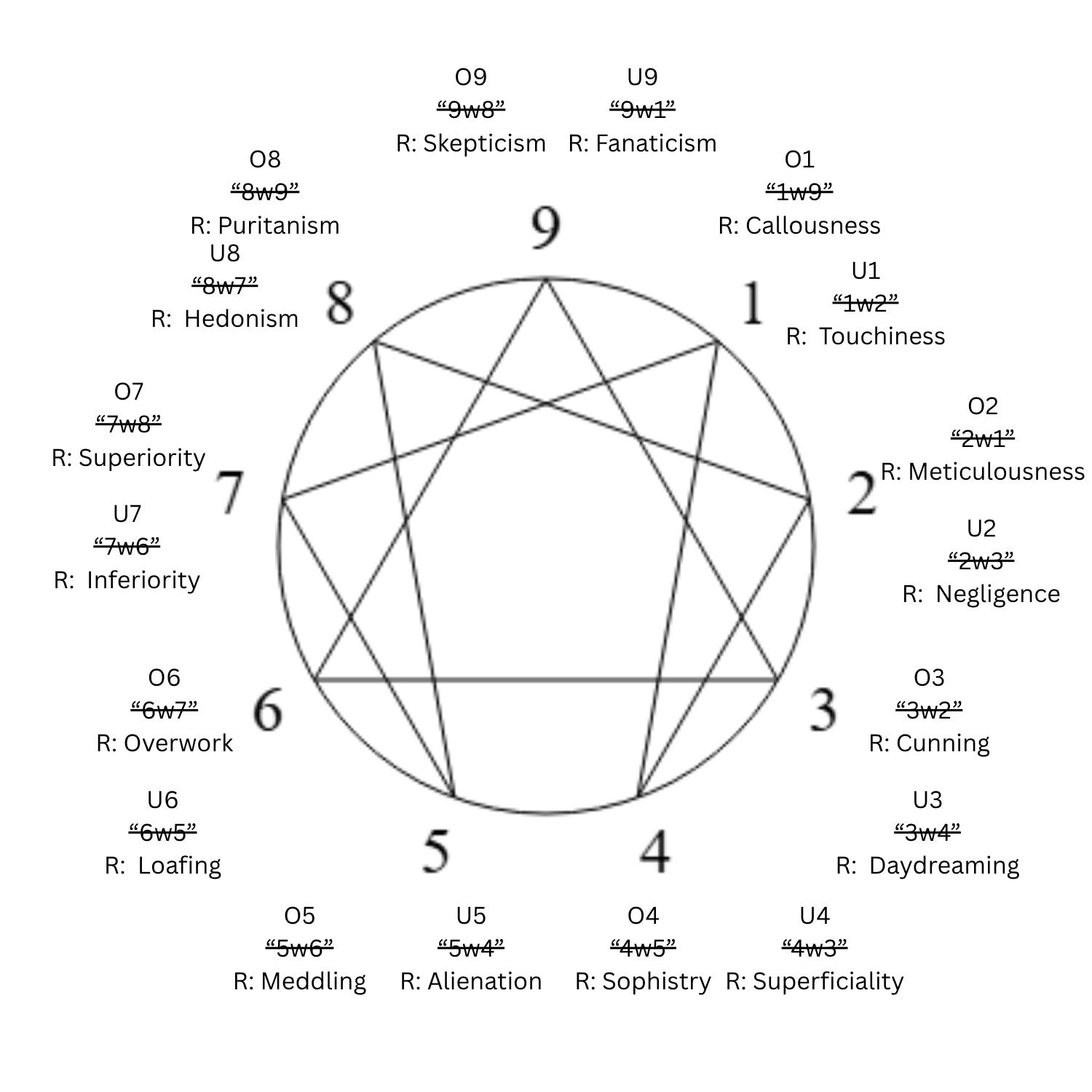
This point of view enables the movement an ego can take within their fixation, instead of boundlessly and pointlessly moving outside of it. Within a future post, I will dissect the over-under expressions of each type and break down their qualities.
One doesn’t need to know their ‘wing’, nor should they exist in the first place. You probably ‘feel’ like both your adjacent types because their structures inherently interwork with your positioned type; it says nothing about your personality.
I suppose I'll get more clarity when you say more on your stance that "you don't have all 9 types". Until then, however, I'm curious why, if each point is structurally interconnected with its adjacent points as you said, that its unreasonable to conceive a person being "lopsided" and having their egoic "center of mass" nearer to one adjacent point than the other. It also seems that the over-under dimension you described could coexist with the notion of wings- it doesn't appear to be mutually exclusive.
All that said, if your fundamentals are different than mine, the details are a moot point.
Curious what more you next have to say on the core fixation process.